
Eye of the Storm: A Story of Cooperation During Disaster
I was in Eagan, Minnesota, just outside the friendly confines of the Twin Cities, for NCG's fall membership meeting in late September 2024, when news of Hurricane Helene started to intensify. Over a hundred co-ops were represented that week, including several from the western part of North Carolina — Hendersonville among them. I remember sitting in the hotel lobby with Damien, the Hendersonville Co-op GM, both of us checking our phones as the storm tracked toward the mountains. I was flying into Asheville just a few days after the meeting, to attend a family wedding in nearby Scaly Mountain, NC.
Bobby Sullivan, general manager of French Broad Food Co-op in Asheville, wasn't in Minnesota. A prior commitment had brought him to New York City that week. Nicole Villano, Strategic Development Manager at National Co+op Grocers was staying in close touch with him by phone and text as the storm closed in — neither of them yet knowing how bad things were about to get for their beloved communities, and towns.
Approaching the 2nd anniversary of this catastrophic hurricane, I sat down with Nicole to ask about her experience during, and immediately following the storm. The following account is a true story of cooperators coming together to care for each other, and their community in its time of greatest need.
“I’ll start by saying my heart is in the North Carolina mountains. I went to Appalachian State University. I lived in the Asheville area when my son was born,” Nicole explained at the very beginning of our conversation. Not that she needed to. You can hear it in her distinctly Carolinian lilt, but also in the passion and compassion in which she speaks of the region.
Nicole was mid-meeting with her NCG peer group, and the conversation turned to “Oh wow, there’s some really bad weather heading towards North Carolina” Nicole recalls saying. In the middle of that meeting, Kirsha, GM at Chatham Marketplace Co-op (hailing from Chatham County, NC), exclaimed, "Oh my God, I just got a text from my kids. They're in the bathtub. They're surrounded by tornadoes.” Sheltering in a bathtub while tornadoes touched down around them. Helene was tearing through, and terrifying the southern Appalachians.
Nicole continues “And then once that day was over, I got on my phone and was getting all the news about this terrible weather event that even affected the geology of the area.” (Once a geology student, always a geology student. Go Mountaineers!). “And then all the little towns they're naming off. I'm like, these are the little towns that I visit and I love. And I was really just beside myself with grief as the news was coming out and the images of the destruction.”
Preparing to depart Minneapolis, Nicole’s mind went immediately to Bobby.
A Friendship Forged in the Co-op World
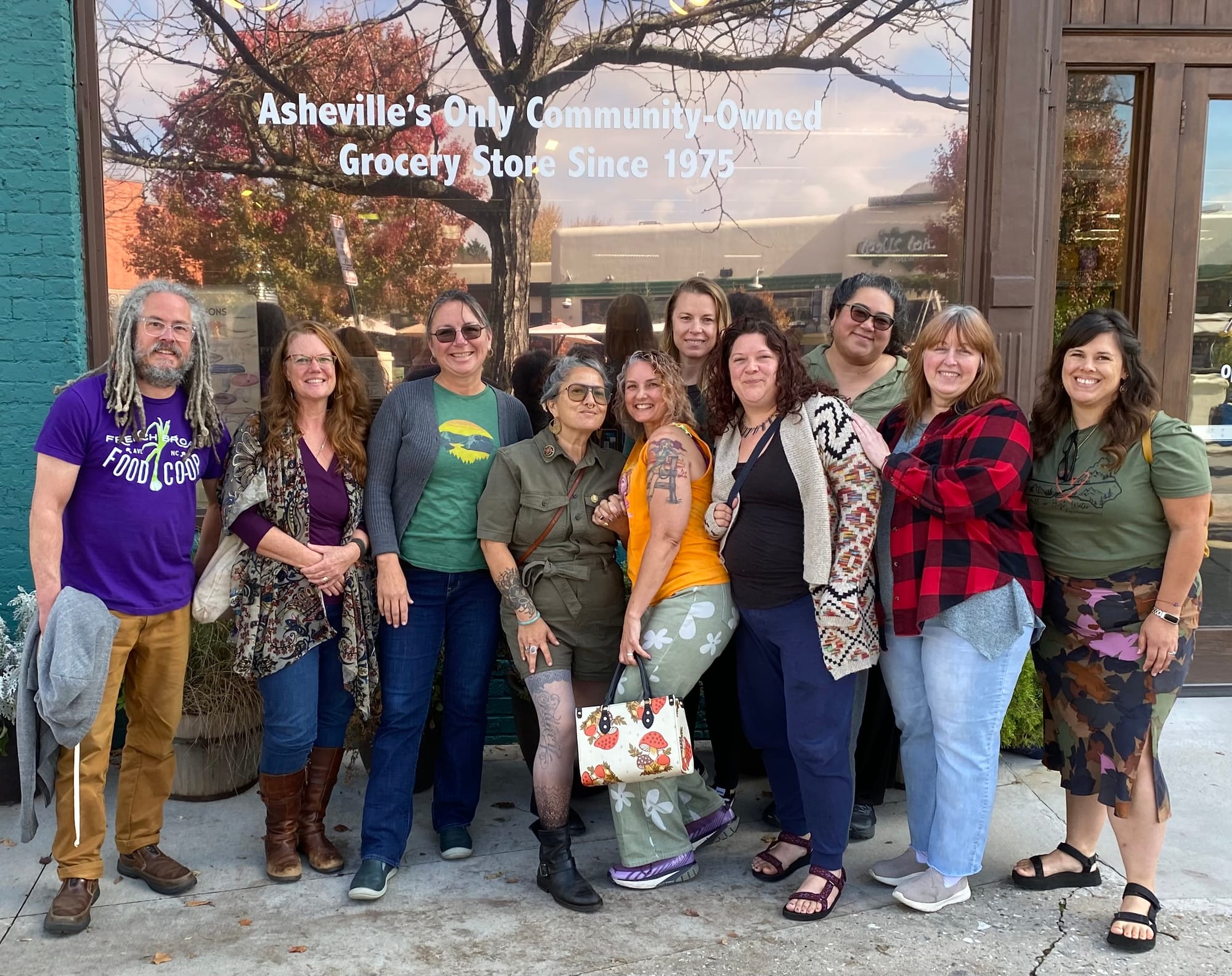
Nicole and Bobby's bond didn't start with the hurricane — it goes back to around 2017, to a friendship built the way a lot of them are in this world: through work, through conferences, through running into each other at airports, and a shared history in natural foods retail before they both landed in cooperative grocery. It's the kind of relationship that shows up all over this sector — the real-life version of Principle 7; Concern for Community.
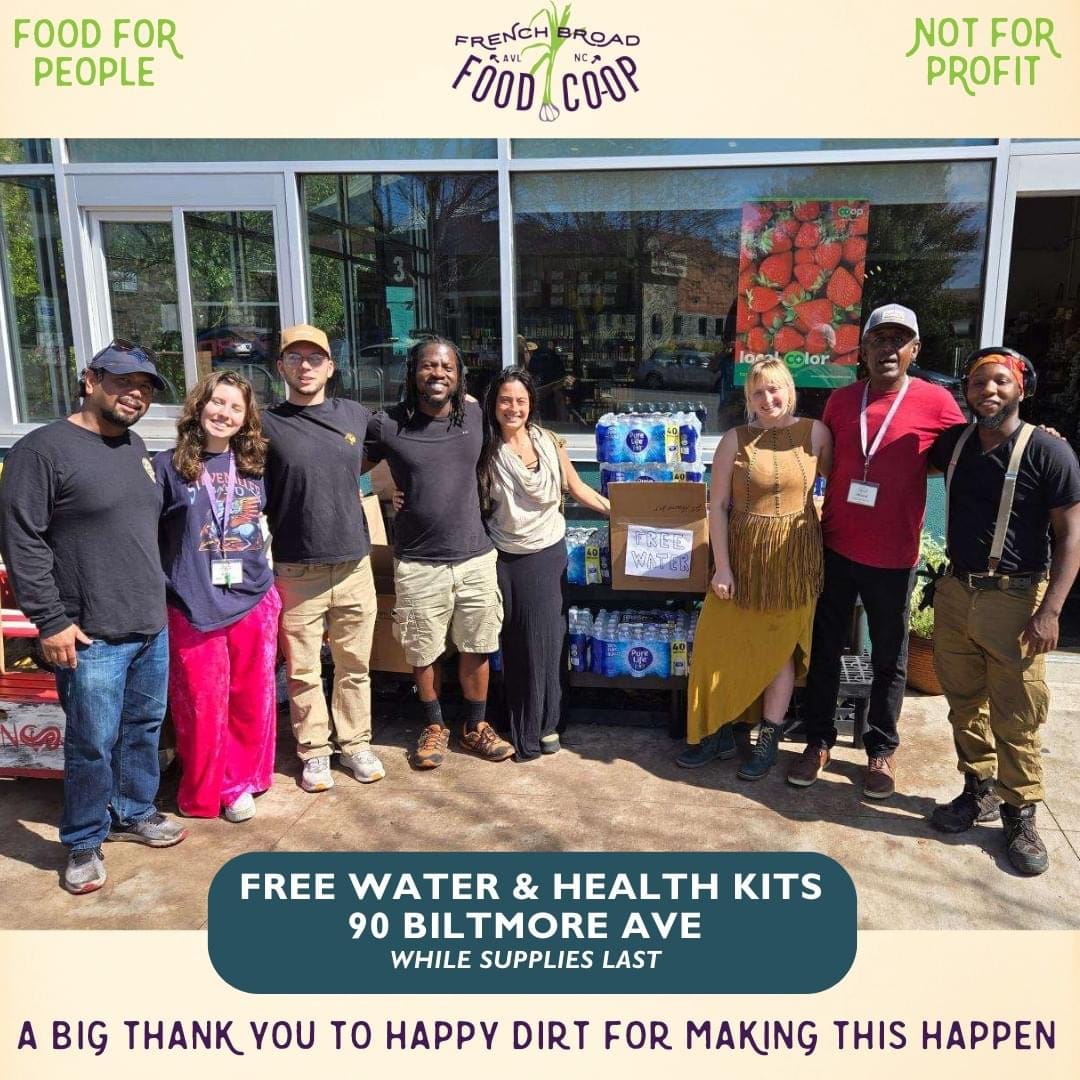
That's really what this story comes down to. Not just one long drive from Charlotte to Asheville, or one dark and empty store, but the deeper truth of the cooperative model: in a crisis, the network holds. People show up. They bring water, food, cash, and toilet kits — and, just as important, they bring themselves.
Hurricane Helene tested communities of the whole region, not just the French Broad Food Co-op, in ways no operational plan could have anticipated. What carried it through wasn't a system. It was people — Nicole, Bobby, the staff who stayed, the neighbors who got checked on — choosing, again and again, not to look away.
“On that day, I reached out to Bobby and I was like, "Hey, are you okay? Is your store okay?”
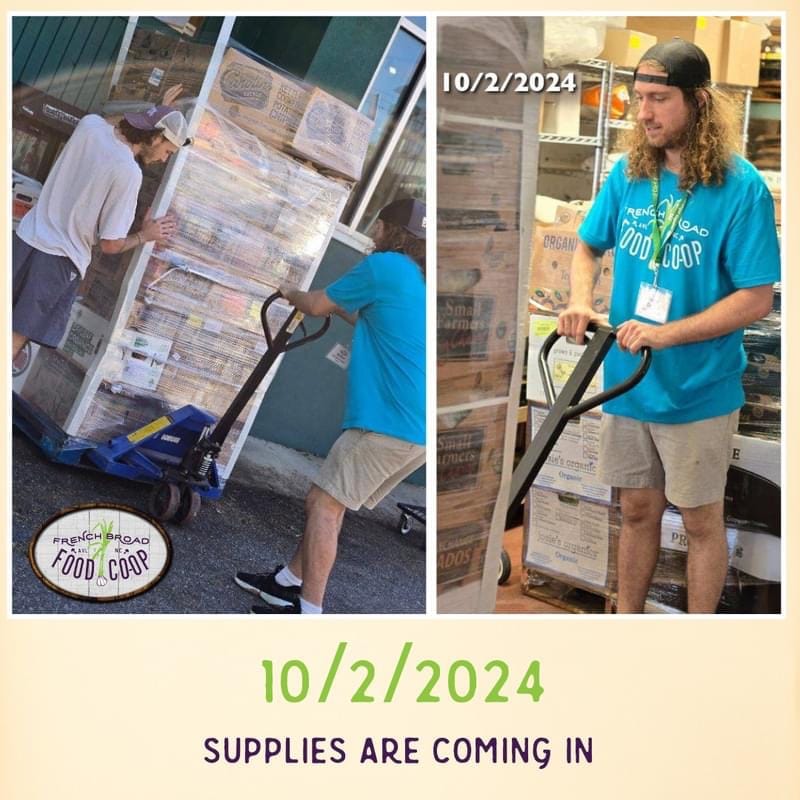
On October 2, 2024 a few days after the storm had dissipated Bobby was still stuck in New York, far from his home, his store, his staff, and a community cut off from the rest of the world. She knew roads were washing out. Cell service was going dark. Asheville, a city a lot of people assumed sat too high and too far inland to flood like this, was in the middle of one of the worst disasters the region had ever seen.
From Nicole’s recollection of that conversation with Bobby, he reported “I’m actually stuck in New York. They canceled my flight home, but they rebooked it for tomorrow.” She called him again the next morning. "You know, they're saying there's no flights in and out of Asheville, and it's not going to happen, I don’t think you're gonna get to Asheville.”
Getting Bobby home wasn't going to be easy. There were no flights into Asheville, that was off the table. So Nicole suggested: fly into Charlotte instead, and she'd meet him there. They'd figure out the rest together.
“Why don't you fly to Charlotte, and we'll get whatever supplies are needed. I'll pick you up. We'll get what you need, and I'll just drive you back to your home.”
It took another day, or two until “he was able to get his flight rerouted to Charlotte, and we met in Charlotte.”
Into the Storm
Before they left for Asheville, Nicole and Bobby started gathering what they could. Cash, because power and card systems were failing everywhere. Supplies for the co-op and its staff. Toilet kits, baby supplies, medicine — the basics for a community about to lose access to almost everything. They knew showing up empty-handed wouldn't do anyone any good.
“It started off with trying to get cash. We had to go to several banks. We had to drive into South Carolina to get cash.”
Nicole was driving while Bobby was calling and texting anyone he could get a hold of. “He was checking in with staff and family and [asking what] supplies they needed.”
What's normally a couple hours' drive from Charlotte to Asheville stretched on and on. Traffic crawled. Four lane highways reduced to one due to flooding and mudslides. And the closer they got, the more the scale of it set in — roads they knew reduced to rubble, whole landscapes reshaped overnight. “It took us the entire day to make like a two hour, two and a half hour trip.”
“We created toilet kits out of buckets. Like little kits with… trash bags and toilet paper, baby wipes, so that they could hand them out to staff, because there's no running water. We stopped and got a bunch of baby supplies and other medicines.” Anything people asked for that Nicole and Bobby could get their hands on.
“And then we made our way up the mountain, and it was just traffic like moving 10 miles an hour, five miles an hour, and we finally made it up there. And you know, we drive into downtown Asheville. It literally felt like an apocalypse.”
Showing Up
When they finally reached the French Broad Food Co-op. The store “was completely wiped out,” and also “possibly gave away all their perishable stuff once they lost power as well.” The people they encountered, as Nicole describes it, were in shock, almost zombified— that particular stillness of people who just watched their world change in a matter of hours. The coop was “just dark, and the shelves are empty.” It was at that moment the emotions of the day began to surge.
What Nicole and Bobby did that day gets at something every co-op eventually has to reckon with: what does it actually mean to show up for each other?
They checked in with staff. They counted the cash on hand — a small, practical act that mattered enormously with no power and no working banks. They dropped supplies at the store and at Bobby's own house, then kept going, making trip after trip to reach friends and community members trapped in their homes by washed-out roads and downed power lines.
“I mean, you had to be in your store. You had to help make decisions, and I knew Bobby just needed to be there. He’s got young adult children and an entire staff and just what can they do to serve their community during this period? And I knew he needed to be there to help make those decisions. So that was another reason why I was like, I think somebody needs to bring you up there. [He didn’t] need to just rent a car and enter into that on [his] own. I knew he needed some support, and he was very grateful to have somebody to kind of decompress with and mentally prepare to walk into what has been described as one of the worst weather events in North Carolina.”
For Nicole, why Bobby being there in person mattered so much is simple. Being a general manager in a moment like that isn't a desk job. It's standing next to your staff and your neighbors when everything else has come apart. It's proof, in person, that nobody's been forgotten.
Bobby sent a message to the membership that read in part, "Greetings Asheville. We are shocked and saddened by all the devastating loss around us. We will continue to do our best to get you the food and supplies you need, but we’re still not sure exactly when we can get deliveries to replenish our stock."
In the weeks and months after, Nicole went back to hike parts of the area she knew well from years of connection to those mountains. What she found stayed with her — familiar trails, familiar sights, places that had shaped her own life there, simply gone. The recovery is still ongoing. Fundraising and rebuilding continue for businesses and families still working to get back on their feet.
Comments ()