
Who Holds The Holder?
Why General Manager Sustainability Is a Cooperative Responsibility
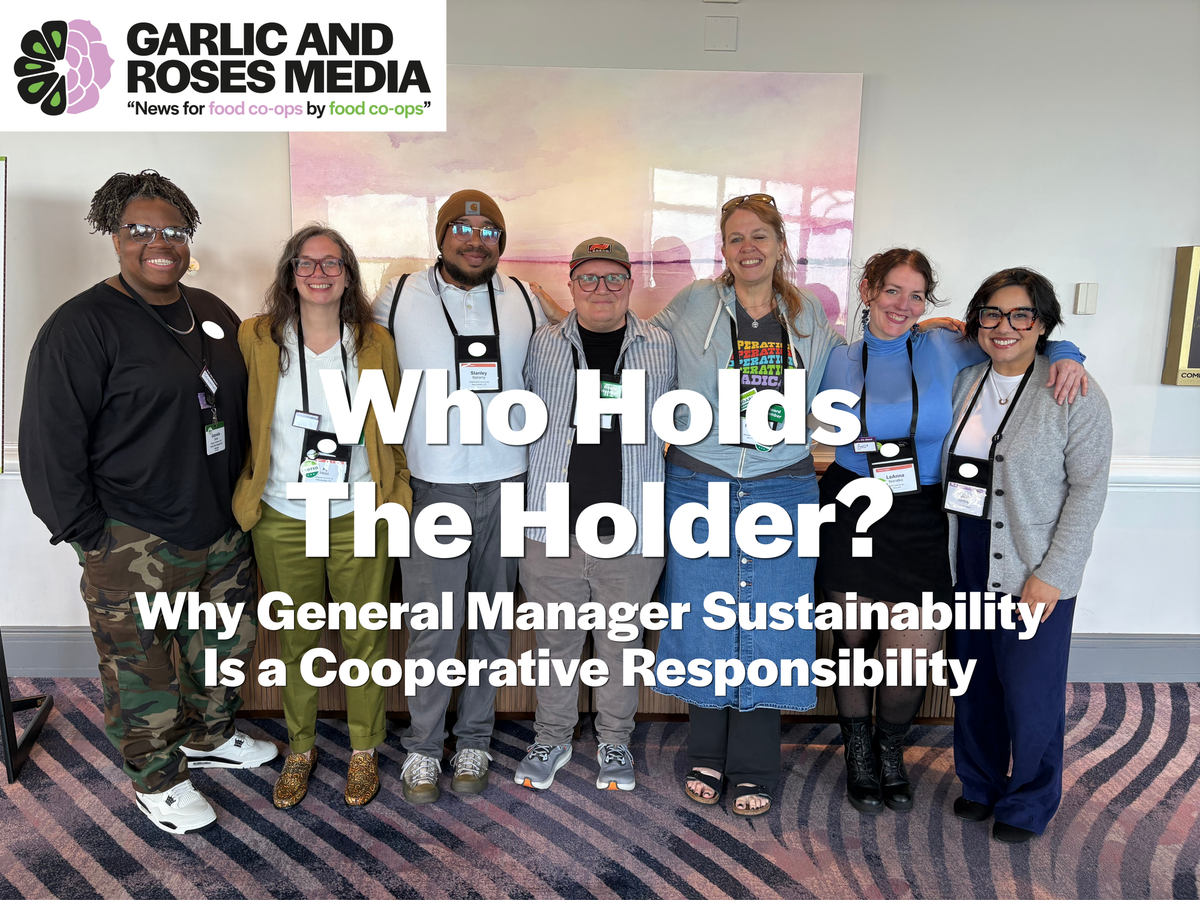
At this year's CCMA conference, I presented Who Holds the Holder: The Board's Role in Preventing Burnout, a session designed to help food co-op board members better understand their role in supporting General Manager (GM) well-being and long-term leadership sustainability. The presentation explored how governance, trust, psychological safety, role clarity and healthy board-GM relationships can either strengthen a leader's capacity or quietly contribute to burnout. While audience questions and discussion enriched the session, one message remained at the center: boards have tremendous influence over whether GMs are positioned to thrive rather than simply endure the role.
As I reflected after the conference, however, I realized the conversation cannot end with boards.
GM burnout is not simply a board issue. It is not simply an organizational issue. It is a cooperative ecosystem issue.
Already this year, our food co-op system has experienced significant GM turnover, and only a small percentage of those departures have been due to retirement (I do not have those numbers to share). Experienced leaders are leaving earlier than expected. Some are choosing different sectors. Others are stepping away from executive leadership altogether. Some boards made the decision to separate from a GM for a variety of reasons. Every departure represents far more than an open position waiting to be filled. It represents years of institutional knowledge, trusted relationships, strategic momentum and community investment walking out the door. Recruiting talented leaders will always matter, but perhaps the more important question is why so many talented leaders no longer see the role as sustainable. Burnout and turnover should concern every person who believes in the future of food cooperatives because leadership continuity is not simply an organizational issue. It is a movement issue.
Perhaps one of the biggest misconceptions about burnout is that it is primarily an individual problem. We often respond by encouraging GMs to become more resilient (ugh...I hate the way this is overused and encouraged), establish stronger boundaries, take vacations or prioritize self-care. Those supports have value, and I would never argue otherwise as I encourage GMs to do all these things. However, they cannot solve challenges that are fundamentally systemic. No amount of resilience can compensate for expectations, structures and cultures that consistently ask one person to carry more than is sustainable.
The General Manager sits at the intersection of governance, operations, finance, human resources, community relationships, member expectations and organizational culture. They are expected to think strategically while solving today's problems, lead through uncertainty while projecting confidence and support employees through challenges while often carrying their own in silence. They navigate labor issues, financial pressures, board dynamics, member concerns, community expectations and an increasingly complex operating environment, often all within the same day. In many cooperatives, they become the holder of everyone else's concerns while having few places where they can safely place their own.
Boards absolutely have a significant responsibility. They establish expectations, evaluate performance, build trust and shape the working relationship that often has the greatest influence on a GM’s experience. A healthy board-GM partnership can be one of the strongest protective factors against burnout. An unhealthy one can accelerate it. Yet even the strongest board cannot create sustainable leadership in isolation. And boards can burnout too. They need to be sustainable as well.
General Manager sustainability is influenced by every relationship surrounding the role. National organizations create learning opportunities and peer networks. Wholesalers influence operational realities. Lenders shape financial pressures and possibilities. Executive coaches provide spaces for reflection and growth. HR professionals strengthen workplace systems. Fellow General Managers offer wisdom, empathy and perspective that only peers can provide. Member-owners influence expectations of leadership, and outside consultants can either lighten the load, unknowingly add to it or create conditions that involve them coming back to provide similar services. Every interaction within our cooperative ecosystem has the potential to strengthen or weaken a leader's capacity to remain in the role.
Principle 6, Cooperation Among Cooperatives, reminds us that we accomplish more together than we ever could alone. Principle 7, Concern for Community, challenges us to think beyond immediate transactions and invest in the long-term well-being of people and organizations. I believe those principles also invite us to think differently about leadership. Supporting General Managers should never rest solely on one board or one individual's capacity to persevere. It should be reinforced by an entire network that recognizes sustainable leadership as essential to a thriving cooperative movement.
Leadership transitions are expensive in ways that financial statements rarely capture. Executive searches require time and resources, but they also interrupt strategic initiatives, affect employee morale, shift board attention away from governance and create uncertainty throughout the organization. Communities lose trusted relationships. Staff lose consistency. Boards lose momentum. Every unexpected transition represents an opportunity to ask not only how we replace a leader, but how we create conditions where exceptional leaders choose to stay.
Psychological safety is often discussed in relation to frontline employees, yet leaders need it just as much. GMs deserve relationships where they can acknowledge uncertainty, ask for help, receive honest feedback, navigate conflict and make mistakes without fearing that vulnerability will be interpreted as weakness. Sustainable leadership is not built through individual resilience alone. It is built through cultures where trust is reciprocal, responsibility is shared and support is viewed as a strength rather than a luxury.
Because this conversation is too important to rely solely on anecdotes, I launched a survey for current, former and interim food co-op GMs. My hope is to better understand not only the challenges contributing to burnout, but also the conditions that help leaders remain healthy, effective and committed to cooperative leadership over time. The findings will help identify patterns, elevate promising practices and inform future conversations about how boards and the broader cooperative ecosystem can better support leadership sustainability. If you currently serve or have served as a GM, I hope you will consider participating. If you serve on a board or work elsewhere in the cooperative ecosystem, I hope you will share the survey with the GMs in your network. The more perspectives gathered, the more equipped we will be to move from assumptions toward meaningful action.
Food cooperatives have long challenged the idea that conventional business models are the only way forward. We have demonstrated that democratic governance, shared ownership and community-centered values can build sustainable organizations. I believe we now have an opportunity to ask a similar question about leadership. If we truly believe people are our greatest strength, do our systems reflect that belief for the people carrying the greatest responsibility?
GM burnout is not inevitable. High turnover should not become something we quietly accept as the cost of cooperative leadership. Leadership sustainability is not a benefit reserved for a fortunate few. It is a shared responsibility that touches every corner of our cooperative ecosystem.
When we ask, Who holds the holder? perhaps the better question is this:
What kind of cooperative movement are we building if the answer is still, "Not enough of us?"
Go drink some water.
Comments ()