
Garlic and Roses Presents: Allanah Hines
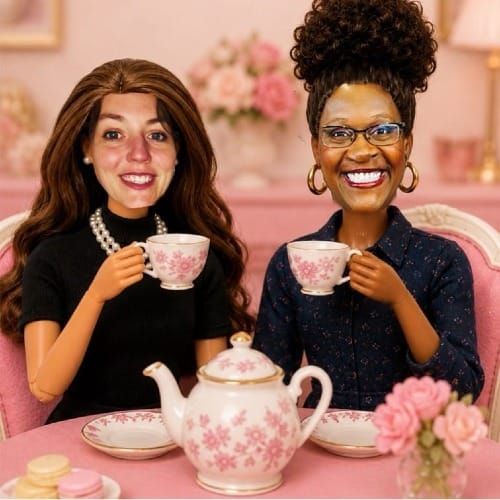
Noticer. Builder. Talker.
An interview with LeAnna Nieratko
Allanah Hines recently gave a characteristically high-energy presentation on belonging that included Black Barbie and the significance of seeing yourself reflected in the things around you. As a former youth and Barbie enthusiast, this example really spoke to me. So naturally, when we meet again, I tell her I would like to start by discussing Black Barbies.
She immediately has news.
There is a new Whitney Houston Barbie. It is sold out. Allanah wants one. More importantly: “It looks like her.” This launches us briefly into one of the less celebrated failures of representation: dolls that are ostensibly Black but, as I put it, still just look like the existing Barbie mold, “but brown.”
This is a pretty good introduction to a conversation with Allanah, who moves easily and excitedly from topic to topic. Over the next hour and a half, we will get from Barbie to pediatric neurosurgery, prepared foods, data systems, racial equity, SNAP, cooperative history, startups, cold-chain logistics, and rotisserie chicken.
“I’m a talker,” she tells me when I ask her to describe herself. “I think I must have come out talking.”
She grew up around medicine. Both of her parents were doctors, and for years Allanah imagined becoming a pediatric neurosurgeon. But with time, medicine eventually gave way to another possibility: culinary school.
Allanah took a job at a nearby co-op because the Culinary Institute of America required work experience. The fact that it was a cooperative was almost incidental. She had barely shopped there as a college student, “It was expensive” Still, the co-op had a kitchen and Allanah wanted to cook.
She started in a kitchen-adjacent role making coffee and selling bread and pastries. While she was waiting to get a cooking position, she spent her time on the retail side doing something that she does best: She started noticing things.
She noticed operational things: how different brands were merchandised, or the seasonality of items. She also noticed who was in meetings and who wasn’t. She noticed who worked in customer-facing jobs and who worked in the back.
With each of these observations, Allanah would see a system, figure out how it worked, and then start asking why it worked that way.
When illness eventually moved her out of the storefront and into back-end work, she became a data coordinator. Suddenly she was building forecasting systems and ways to calculate shrink, working on labeling requirements, and helping develop the branding for the co-op’s prepared foods. Reader, please note: these are wildly different skill sets.
By 2020, Allanah had also spent years noticing something else. She was often the Black person invited into the room, sometimes when she wasn’t an obvious invitee based on her position.
“Interesting,” she says several times as she tells me these stories. Not in the fun-fact way, but the narrowed-brow, drawn-out way. “Interesting.”
Then George Floyd was murdered.
The co-op’s board issued a statement condemning injustice. Employees in the co-op’s internal chat originally responded positively, pleased that the board was saying something. Allanah saw the undercurrent of differing opinion, and when Black employees began asking what the organization itself was going to do, Allanah watched the conversation change.
She remembers one employee questioning a fundraising effort and asking why the money wasn’t being directed toward something addressing police brutality or supporting Black communities.
More Black employees spoke up.
And then, Allanah says, came silence from leadership.
On a Sunday night, she wrote a message of her own.
“The silence is deafening,” she remembers writing.
When she hit send, she cried for an hour.
When I ask where that emotion came from, she answers immediately. “Anger. It was pure anger.”
She had spent years understanding herself as, in some ways, the “acceptable” Black employee: invited into certain meetings, familiar to leadership, able to move through the organization in ways other employees could not. Watching Black coworkers speak plainly and still not be heard made that position impossible to ignore.
“When I hit enter, I was willing to lose it all.”
She also knew she had protections some of the other employees didn’t. She made more money. She had a strong support system. She didn’t have children depending on her paycheck.
So when leadership gathered the employees together and asked what they wanted to do, Allanah pushed back on the question itself. She didn’t want lower-paid employees carrying the risk of telling leadership what leadership should already have been hearing.
The specifics here are Allanah’s, but this isn’t simply a story about one co-op. Her experience sits inside a much bigger reckoning familiar to many food co-ops that came out of the 1970s: organizations founded on big ideas about equality, democracy and community that eventually had to examine the difference between believing in those values and understanding who actually experienced them.
Those conversations eventually led to the creation of a DEI Manager position, with Allanah in it.
She had absolutely no idea what she was doing.
“The first year was terrible,” she says. “I didn't know what I was supposed to do. And there was a lot of internal reckoning at the same time that I'm, like, guiding this team of people that haven't liked me at least for the past five if not 15 years because I'm coming in and I'm, like, changing all this stuff.”
The “stuff” here is wide ranging, from suggesting meals for one or two during a COVID Thanksgiving to questioning hiring criteria that sounded neutral until she compared them with who was actually being considered for leadership.
Not only was this a new position for Allanah and for the co-op, it was deeply personal work to navigate as a Black woman living in the very space that needed change.
“Knowing for so long I had seen all of these things… almost every example was something that had been done to me within the co-op… I'm in the group of the managers [who] ‘would never do anything like that’ and, I was like, ‘Well, it's been done to me.’”
Still, the resistance did not slow her down.
The work could be big and structural: examining pay and promotion patterns or questioning why certain groups of workers seemed concentrated in particular roles.
It could also be small and incredibly practical: finding the right translator for Burmese employees at staff meetings or getting coloring books for the children of employees who had to bring them along.
This may be one of the more revealing things about Allanah’s approach. Belonging can sound enormous and philosophical right up until someone cannot fully participate in a meeting because they do not understand the language being spoken, or because they have their kid with them at a meeting and that kid needs something to do.
Then belonging becomes logistics. Somewhere in that work, Allanah found what made the role click. As she says, “This feels like an intersection of everything that I love.”
Today, Allanah works with new cooperative grocery projects, helping them figure out how to become actual grocery stores.
She loves it.
Startups, she has discovered, are puzzles.
“I love puzzles. Always love puzzles. The more pieces the better, the harder the better.”
Her work now ranges from helping individual projects to building tools and bringing together the different people involved in starting a store: the people conducting market studies, the people reading them, the people lending money based on them, and the communities trying to understand what any of it means.
It’s also being, as she puts it, “a part of that conversation both internally and externally of the realness of it.”
Underneath all of it is a reality Allanah is willing to say plainly:
“At the end of the day, it’s a grocery store and you have to make money as a grocery store.”
She is equally interested in the history co-ops carry into that work. Food cooperation, she points out, did not begin and end with the grocery stores that survived long enough to become institutions. There were general stores, purchasing clubs, food-sharing networks, community land trusts, and informal systems built because people needed food and figured out how to get it to one another.
“There's a lot of history. And because I'm a Black woman, I'm looking at, you know, the mostly Black co-ops, but also realizing… when we talk about a food co-op, it's not always a grocery store. Grocery stores became popular like everything else. So, you had general stores, you had stores, but you had just a lot of food sharing. So, I would love to see as a cooperative movement a push again towards history and education, what got us here.”
This history is far more diverse in people, cultures, and concepts than much of the modern discourse would have us believe.
The Rochdale Pioneers, Allanah says, “did super-duper great things.” But she compares the way we sometimes tell cooperative history to the familiar claim that Christopher Columbus discovered America. “You can't discover what's not lost.”
Allanah’s thought process is oriented toward what happens if we get to build something with all those lessons already inside it.
After reflecting on the road to now for a bit, we turn our focus to the future. I ask Allanah: If she couldn’t fail, if resources were abundant, what would she do?
She pauses. “Oh my gosh.”
And then it turns out she has an answer.
Actually, she has the whole thing planned.
Allanah would build a self-sustaining food campus in North Carolina. She wants it based at North Carolina A&T, an HBCU, with the university owning it and benefiting from it. Its food science students would be part of the work. Small farmers, particularly Black farmers, would have a place to sell. A kitchen would turn local produce into value-added products and incubate food entrepreneurs. And then she gets to the part that really lights the fuse: Cold-chain logistics.
Because of course Allanah is excited about logistics.
There is a more succinct version of the vision, too.
“I want to fuck it up,” Allanah says of the existing system. “I just want to tear it down.”
By this point, the supposedly random collection of skills from earlier in our conversation looks almost suspiciously coordinated.
Food. Health. Data. Systems. Justice. Community.
Talking. Definitely talking.
The aspiring pediatric neurosurgeon who took a grocery job because she wanted kitchen experience is now imagining an entire food system and how all its pieces might fit together differently.
I tell her this. “These skill sets that seem super varied are actually, like, perfectly linked.”
“Yeah,” she says.
This is fortunate for the rest of us. Because Allanah is still noticing things.
|
Lightning Round |
|
|
Listening to: |
Olivia Dean |
|
Favorite thing to
buy: |
Local soaps |
|
Something she would
bring back |
00s era R&B:
Mario, Janet Jackson, 112. All of it. |
|
Co-op Hot Take |
Co-ops need better
flavors of hot rotisserie chicken.
Hot. |
|
First song that
comes to mind with a fruit or vegetable lyric |
Strawberry Fields
Forever |
Comments ()