
Corporate to Co-op

People take a variety of paths to leadership at a food co-op. Some are promoted from within. Some come from similar independent stores or other natural foods outlets. A third group that interested me was people who come to the co-op world after having working at a corporate grocery chain. What was their impression upon arriving at a co-op? And more importantly, why did they stay?
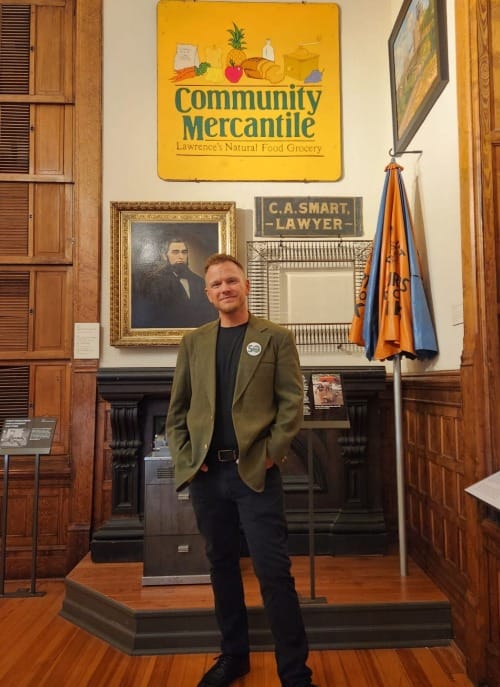
I reached out to Seth Naumann, General Manager of The Merc in Lawrence, KS. Naumann worked for over a decade with Kroger grocery stores in a variety of roles. His transition to co-ops and his perspective on the difference in culture are interesting as we consider the places we can attract and retain the next generation of talented co-op managers. Here's our interview:
MH: How did you get your start in grocery?
SN: I was working at a Chrysler factory fresh out of high school. When the US automotive crisis hit during the Great Recession, my factory shut down. At the time, I had a 3-month-old and had to make ends meet until I could find another factory job. I accepted what I thought would be a very temporary position at a Kroger store as seasonal help just to get by until another factory returned my call. The drive, efficiency, and ability to flex into any shift that I brought with me from my factory experience impressed the leadership team, and I was quickly promoted. Since the working conditions of the grocery store were much more hospitable and my compensation became increasingly more competitive, I decided to stay in the grocery business and gave up my dreams of working another factory job. Almost 20 years later, I don’t regret my decision to remain in the grocery business.

MH: What was your early career path? Where were you working, and how did you move your way up?
SN: I began my grocery career as a part-time, seasonal hire in the general merchandise department at a Kroger store under the regional “Gerbes” banner. My primary job was setting the seasonal aisle overnight. It taught me a lot about merchandising, UPCs, planograms, signs, tags, and gondola shelving.
What typically took three people three nights to complete took my trainer and me just under two nights to set. That caught the attention of the store manager, who called me into his office to inquire about the work that I had done. I thought that I was in trouble, apologized for going too fast, and asked if there was any way that I could make up the extra night’s worth of hours that I needed on my check. He said, “On the contrary, it seems like you have a lot of potential. Would you be interested in working full time?”
From there, I was assigned to break down large, overnight grocery deliveries by aisle. Not only did I learn the aisles, but I began sorting the stock carts into the sections and categories of each aisle. This allowed stock clerks to work the boat one section at a time without wasting labor walking up and down the aisle for each individual item. In a short amount of time, I had drastically improved the overall efficiency of the grocery department. Trucks were consistently fully stocked by store open, regardless of truck size or call-ins.
I leveraged my knowledge of product location to secure a job as the scanning manager—executing price changes and producing signs and tags for all items. Within several months, I had made extensive efficiency improvements in the scanning department and let my store manager know that I did not need all of the labor previously allocated to the department. Rather than simply cutting the hours, I requested that I be allowed to spend my labor learning skills in other departments while my team completed the scanning tasks. He obliged, and I began learning total store operations.
I bounced from department to department until I felt prepared enough to apply for the management training program. After being accepted into the program and graduating, I was assigned to a Dillons store in rural Kansas and signed a contract agreeing that I would work a minimum of 55 hours a week for a salary of $36k a year. In 2011, I thought that this was an extremely generous offer and even posted to my socials that I had secured “my dream job.”
After several years in store management, I accepted a job working for the district as a “coordinator.” My territory consisted of 22 stores ranging from Junction City, KS, to Camdenton, MO. I oversaw produce, front-end, and grocery in various coordinator positions within the district. There was always a store grand opening, an executive walk, a refrigeration loss, or some other fresh hell that would pull me away from my family for weeks on end. By 2019, I was exhausted, unappreciated, and relying heavily on alcohol as a means of dealing with the stress of the position.

MH: When did you first hear about co-op grocers?
SN: Prior to working at The Merc Co-op, I had only ever been inside of it twice: once for a class that they were hosting for my daughter’s elementary school (we learned how to make hummus) and another time when one of the Dillons stores in Lawrence made a failed attempt at recruiting local produce vendors.
When I was ready to leave Kroger, I applied at all of the Lawrence, KS, grocery outfits that I could think of—Target, Walmart, Hy-Vee, Aldi, and Sprouts. Most of them either didn’t call me back or wanted me to start from the ground up in a management training position with relocation expectations. The co-op that was only a mile from my house never even occurred to me as a potential employer because they weren’t part of the corporate grocery machine that had raised me.
In retrospect, I think that The Merc being the only food co-op in Kansas probably compounded my perceptions. Had I grown up somewhere like the Twin Cities, where food cooperatives are more revered and synonymous with grocery, I may have been more apt to work at one.
MH: What made you apply to a job at a co-op? What were your expectations about working at a co-op at the time you applied?
SN: In 2019, one of the grocery managers that I was working with in Manhattan, KS, told me that she had a former colleague in Lawrence, KS, who was actively trying to recruit her to work at the co-op in town. She shared that while she was not prepared to move an hour and a half away, she knew that I was living in Lawrence at the time and said that it seemed like I might “benefit from a change.”
As for my expectations of working at a co-op, I had little familiarity with them other than the stereotype of co-ops being somewhat of a “hippie haven.” Ironically, the HR director of the co-op at the time was especially eccentric. He had long, curly hair, smelled of essential oils and had a peace sign tattoo on his forearm. Inside of an office adorned with crystals, the first question that he asked me was, “When was the first time that you realized that you were white?” While this was a fantastic question that can quickly and effectively gauge a candidate’s perspective on EBIA, it was fairly jarring and unlike any corporate interview question I had ever received. While the HR director was very friendly, he seemed like more of a co-op caricature than I could have imagined in my wildest dreams. I remember leaving and telling my partner, “They really drink the Kool-Aid there.”
During my second-round interview, I was met by a panel of people who seemed much more like my peers from Dillons—many of whom were also corporate refugees like me. We all laughed and shared wild grocery stories with one another in what felt more like a game night with friends than an interview. After being invited back for a third interview, I waited two months before I heard back from the co-op. The mentality that my corporate tenure had left me with created the most horrible narratives in my head: “They don’t want a corporate guy like you… You aren’t good enough… You don’t have the right experience…” Finally, in September of 2019, I received the call and was offered the job of store director at The Merc Co-op!
Years later, I realized that I had been conditioned by toxic work culture to believe that I couldn’t leave, that I was an unfit candidate, and that nobody would want to hire me, regardless of my qualifications. When I finally shared with my GM how I had felt while awaiting their return call, she told me, “You were a freaking unicorn! We were just taking too much time trying to figure out how to squeeze you into the org chart. There was no way that we were going to find a candidate as qualified as you.” And just like that, I realized my worth. And as for that eccentric HR director—we became best friends.
MH: What did you love most about working at a corporate grocer that co-ops don’t have?
SN: Standardization of everything—they are fantastic operators. My time in corporate was like grocery boot camp and taught me everything that I needed to be a highly effective grocer. At times, it was also nice to be able to say, “Corporate is making us do this,” versus everyone knowing that all decisions at the co-op are made internally and, if they fail, it’s your fault.
MH: What do you love the most about working at a co-op? What’s kept you in the co-op system?
SN: Absolutely everything. I tell people all of the time that “the co-op saved my life,” and I legitimately mean that.
The freedom and work-life balance that came with my cooperative career path, combined with knowing that the work I was doing was more fulfilling and part of something bigger, allowed me valuable time with my family, kept me increasingly motivated, and left me with enough energy at the end of the day to focus on my personal well-being.
In just a couple of months, I will celebrate 6 years of sobriety. Additionally, I have gone back to school to pursue my bachelor’s degree and have been laying the foundation for my professional consulting firm. There is no way that any of this would have been possible while working 70 hours a week for Kroger. Not only was I able to reestablish my self-worth, but I also had space to explore avenues for self-improvement and room to identify what I found the most valuable.
Supporting local businesses, prioritizing sustainability, creating new avenues for food access, and being at the forefront of inclusive business practices are all things inherent in my work that I can no longer imagine sacrificing. In some ways, I guess you could say that I “really drink the Kool-Aid” now.
MH: Anything else you’d like to say about the differences between corporate grocers and co-ops?
SN: Coming on the heels of an announcement from Kroger that they are planning to lay off 3,000 positions with the intent of replacing them with AI, there is no time like the present to get out the word about co-ops. NCG reports that the cooperative sector is on track to have a record number of turnovers in General Manager positions in 2026, and there are a ton of people who are trained up and waiting in the wings to help us propel the cooperative movement forward. Perhaps these folks are just unaware, as I was, that cooperatives are a better version of what they are already doing. It is our job as cooperative spokespeople to get the word out and help them find their way to a better future—for them and for us.


Comments ()